
“Do you want to see my name in the obituaries, or do you want to be a hero and save my life?” – Ethan Winters
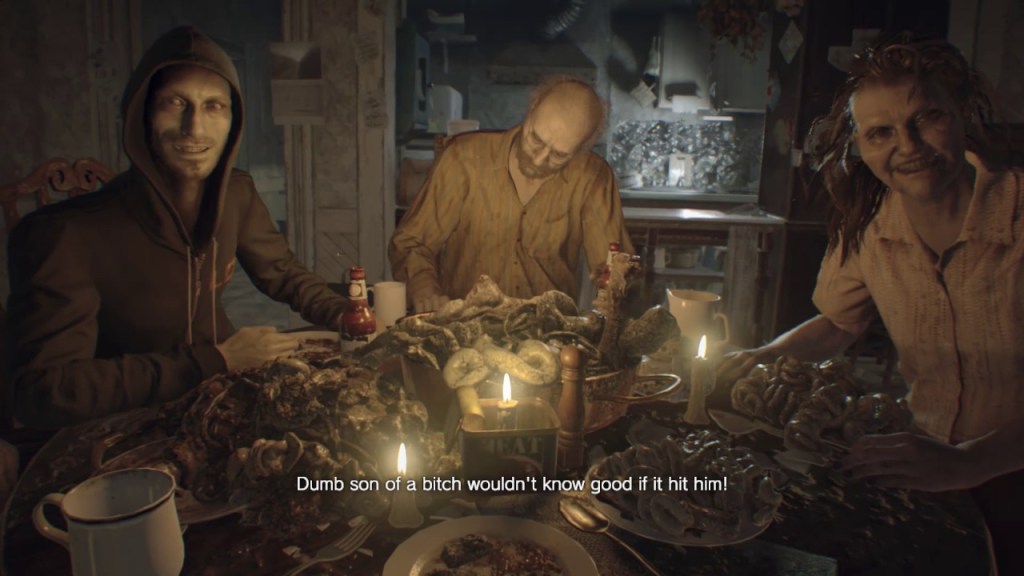
This piece analyzes Resident Evil 7: Biohazard in specific relation to previous criticisms as well as mobilizing critical ideological perspectives (race and gender). Resident Evil 7: Biohazard, having been released in 2017, in reaction to the accusations of insensitivity, attempts to construct a more diverse world whilst blaming ‘trashy’ families for immoral contagious exploitation. In reference to André Brock’s critical racial and gendered analyses, in working with Resident Evil 5, Resident Evil 7 makes an obvious effort to reduce the racist and sexist imagery and articulations. Of course, RE7 still works within what André Brock notes as “Blackness [operating] as a boundary for White identity and values” (2011, p. 432). Throughout the game, there is one notable POC character – that of a police officer (though his debut and life is short lived). The player, alternatively, embodies the white male protagonist and the dominant ideologies, therein.
The protagonist of the game (and the character the player chiefly operates as) is Ethan Winters, husband of a kidnapped woman, Mia Winters. Ethan finds a video of Mia which pleads for Ethan to stay away and not come looking for her. Ethan, of course, does not comply and finds himself also kidnapped by a group of dangerous and seemingly immortal rednecks – the “family”. The concept of the game is that Ethan is “barely human” amongst impulsive and proto-mortal humans. Ethan is unaware of the actual status of his kidnappers – people who mark the origination of the deadly virus that causes the zombification in other Resident Evil games.
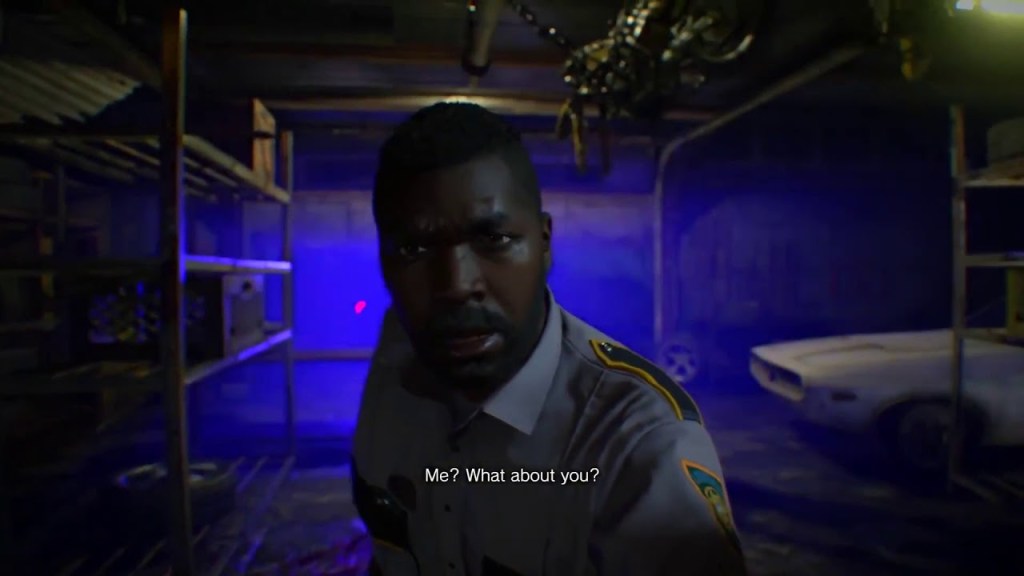
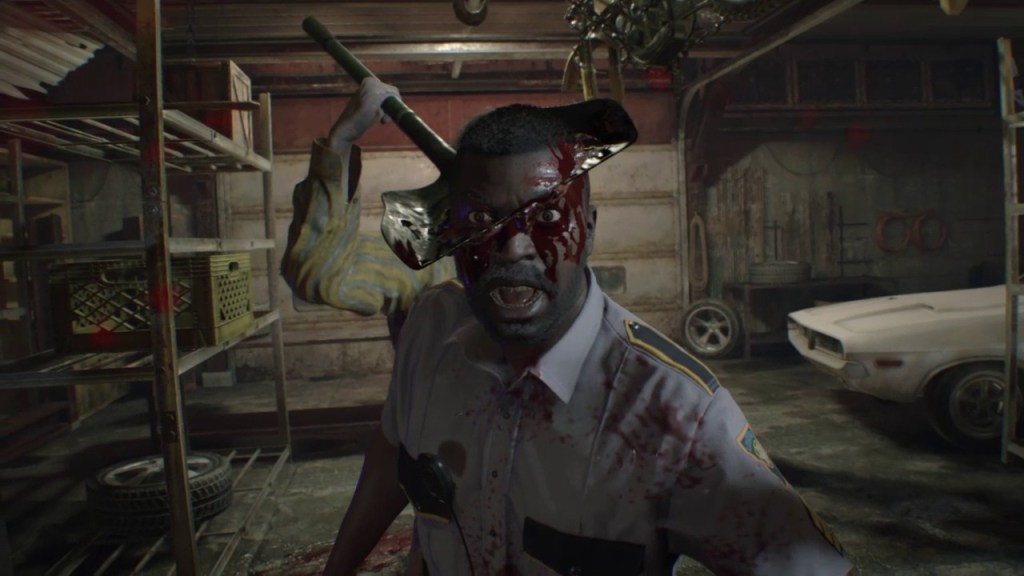
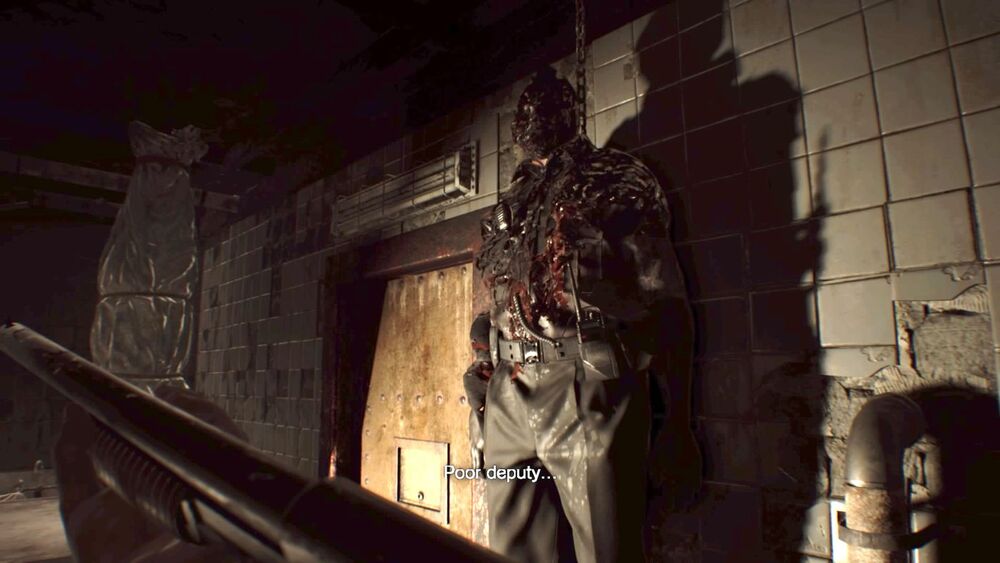
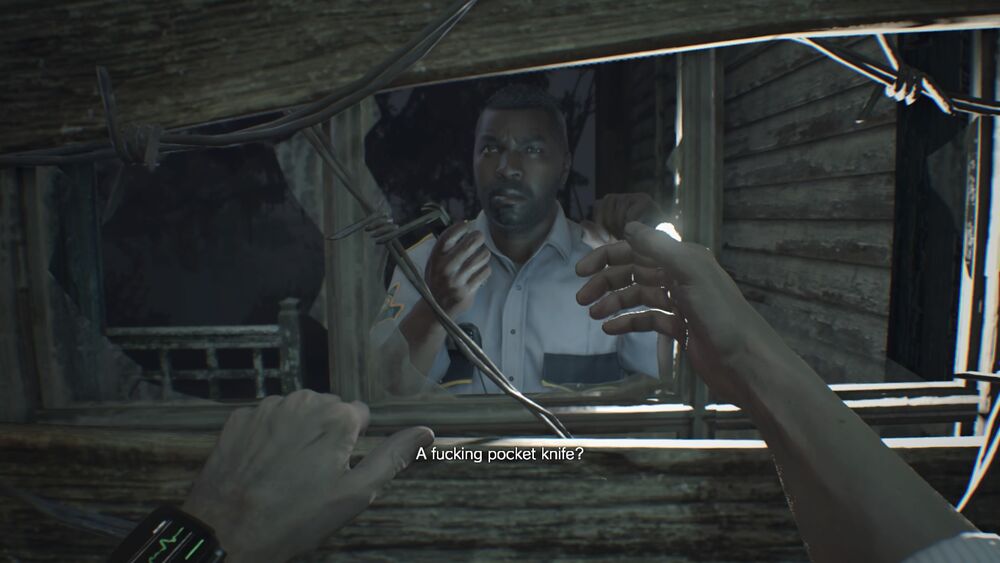
A pivotal moment in the game is Ethan’s correspondence with a police officer who comes to the property. The officer who comes to “rescue” Ethan is the only POC character in the game. After the police officer insists that Ethan meets him in the garage, the officer is shortly killed by the ‘daddy’ of the house (with a chainsaw through his head). Though a short moment in the game, this shot victimization of an “ordinary person” is critical. As mentioned, RE7 tries desperately to shirk accusations of racism – especially following their previous games. In a game like RE7, the zombies (though they are not yet called that) have the usual articulations of zombification: barbarism, immoral compass, ravenous.
The zombies in this game are all white – an interesting option as the “family” chooses its victims to zombify. As Elizabeth McAlister argues in Zombie Theory: A Reader, the horror of the zombie “for white Americans, was the image of the disfigured body dispossessed of its soul, will, agency, and hence its interiority and its very humanity” (2017, p. 74). The zombie mythos, having been figured alongside critical moments of racial inequity, sees zombies as “synonymous with a kind of barbaric racial blackness” (McAlister, 2017, p. 74). As such, this moment of killing the POC officer offers an interesting attempt at indictment of whiteness. By the zombies killing the POC character, the stereotypically coded zombie (one who symbolizes Blackness) engages in a complicated engagement of cipher: one that muddies the clichéd inhuman zombie. This scene in the game, then, evokes an interesting moment: one in which RE7 attempts to critically engage with the mystified racist zombie (as well as their own past). However, cordoning off this critique to a moment in the game is hardly subversive narrative. The shifting significance of the zombie throughout time is multi-racial and multi-cultured. RE7, nonetheless, fails to address this critique in the rest of the game. The acts of the “family” are minimized as “impulsive”, and “irrational” – race is not actually handled in this game (though it would have been a perfect place for it). Here, we arrive at the crux of the issue: if zombies are morally absolved of accountability due to the disconnect between the brain and higher-level functioning, how can their targets be considered in terms of racism? RE7, in this small scene, demonstrates the fluctuating nature of who zombies are while at the same time, diminishing their actions as the creatures are “mindless”.
Despite this, RE7 is an enjoyable game with difficult challenges. The biggest gripe I have is the vacillating attempts to acknowledge race while still trying to transgress boundaries of ‘zombification’ – you cannot have one without the other.
Works Cited
Brock, André (2011). “’When Keeping it Real Goes Wrong’: Resident Evil 5, Racial Representation, and Gamers.” Games and Culture, Vol. 6(5) Pages 429-452.
McAlister, Elizabeth (2017). “Slaves, Cannibals, and Infected Hyper-Whites: The Race and Religion of Zombies.” Zombie Theory: A Reader, Editor: Sarah Juliet Lauro. University of Minnesota Press: London.
 Games and Philosophy