
This project utilizes an ideation deck to pitch a game that envisions within it an aspect of “critical play”. Here are the cards that were chosen:


Penguins of Growth and Mire
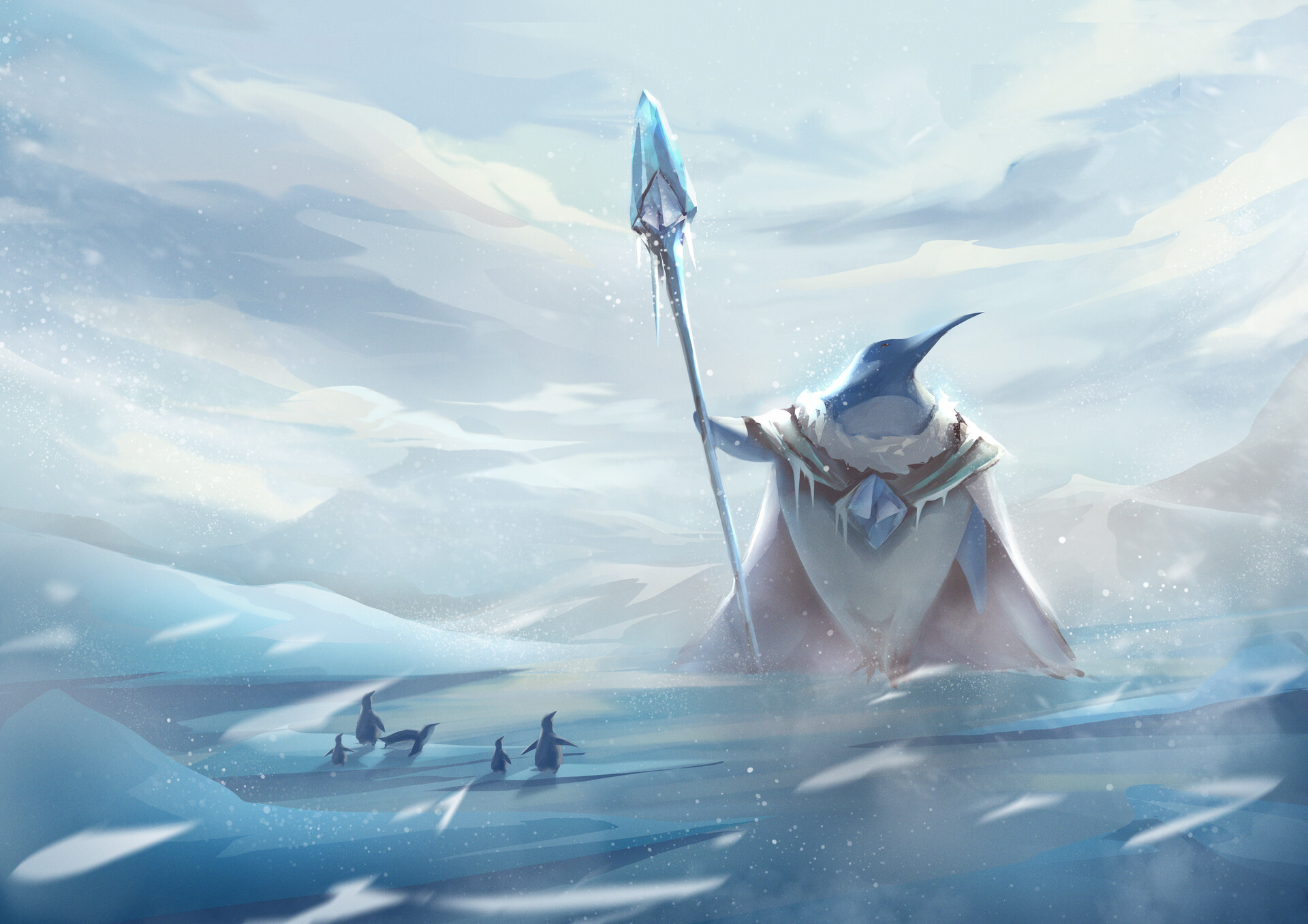
The game I propose is called Penguins of Growth and Mire. The game is a rumination on artificial selection in contrast to the established mechanisms of evolution and the destructive forces available once the ecosystem is impinged upon. The name, Penguins of Growth and Mire, hearkens to the conceptual ‘growth’ found in deciding on evolutionary traits; the ‘mire’ gestures toward abiogenesis and the intertwined reality of creatures smaller than the eye can see (such as bacteria in swamps). The game is meant to serve as an example of the interplay between artificial selection and the delicacy of disruption into established networks.
Penguins of Growth and Mire echoes Mary Flanagan’s notion of “performative games” as discussed in chapter five of her book, Critical Play: Radical Game Design. Using the ideation deck created in class, I drew six cards under the categories: platform (Twine), theme (innovate/change existing features of an animal), genre (strategy), mechanics (implicit moral judgements), design (play as a penguin), and other (involve a love interest). The seventh “avoid heavy-handed didactic explication” is intrinsic to Flanagan’s book and corresponding concepts.
The premise of the game I propose works as follows: the player is an Emperor penguin who is weary of its size in relation to its ancestor Icadyptes Salasi who stood five feet tall (Smithsonian, 2018). Cursing the evolution that got him there, he makes a deal with the god of this world: if he can innovate or change existing features of animals that prove to be demonstrably better than the evolution that got them there, he may also change his size. As the penguin sets off on his mission, he must research and meet many different species to complete his quest. Along the way, he falls in love with a flamingo from Paraguay who quite enjoys anatomy and tells the penguin about the silly evolution of the vagus nerve – thus fueling his quest further. In an attempt to avoid heavy-handed didactic explication, the implicit moral judgements rests on a few notions: that changing evolutionary traits/ knowing better is inherently good and useful, that an artificial re-rendering of traits is easy and can be holistically considered, and that one would even want to help re-design traits.
As mentioned, this game is meant to operate under the guise of ‘performative’. As Flanagan argues, using surrealism as a basis, “performance can also be of use to push through expected cultural norms” (2009, p. 162). The ‘spectacle’ of the game I propose works to employ the ‘strategic’ element of the cards in tandem with becoming intimate with the “role of the body” (as Flanagan argues) (2009, p. 149). The strategy, here, envisions that players invoke imaginative ways to predict and visualize change at a fundamental level. The crux of this game is that it is made in Twine and, as such, would be best suited for a narrative story structure. The game, itself, would present the player with a number of choices for change/ improvement to established bodies of animals. What is not known during this process of choice is that each decision will lead to significant changes in a holistic sense: the broader ecosystem, other animals which live synchronously with the changed creatures, plants, insects, and even humans. Ultimately, the game will be presented as light-hearted throughout with an unconventional love interest (the flamingo with the suspiciously useful insight into anatomy); only when the player reaches the final decisions will they realize that the changes made require a deep engagement with the species and their universal surroundings.
Of course, the ending of this game is meant to evoke a sense of moral quandary in the player and make them question their own implicit moral judgements which were made throughout the game process, itself. In focusing solely on the ‘body’ of the animal, the wider spectrum of ecology and status quo is altered. For example, in changing the colour of flamingos who are distraught at their colouring due to their food intake, the changed feather colours confuses both prey and predators and changes their migratory patterns resulting in catastrophic environmental damage. This game is not meant to be presented as moralistic; rather, it aims to approach the idea of ‘bodies’ as symbiotic with ecosystems and that social disruption caused by artificial selection can be profound.
Works Cited
Flanagan, Mary. (2009). Critical Play: Radical Game Design. Massachusetts Institute of Technology. Cambridge, MA.
Smithsonian. (2018). “Penguins: order Sphenisciformes, family Spheniscidae”. Ocean: Find your Blue. https://ocean.si.edu/ocean-life/seabirds/penguins
 Games and Philosophy